
27.01.2026
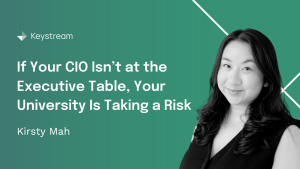
If Your CIO Isn’t at the Executive Table, Your University Is Taking a Risk
Universities don’t fail because their technology breaks.
They fail because their strategy ignores technology until it’s too late.
For years, Higher Education has treated IT as a delivery function – something to be consulted once the “real” decisions have been made. That mindset is now actively dangerous.
In today’s sector, digital strategy is institutional strategy. And any university that doesn’t have its CIO at the executive table is operating with a blind spot.
Every Strategic Challenge in HE Is Now a Digital One
Look at the pressures facing universities right now:
- Recruiting and retaining students in a hyper-competitive market
- Delivering flexible, hybrid, and international learning at scale
- Protecting research, IP, and student data from escalating cyber threats
- Generating insight from data to improve outcomes and efficiency
- Doing more with less in a financially constrained environment
None of these can be solved without technology. Yet many institutions still involve their CIO after priorities are set – when budgets are fixed and expectations are already misaligned.
That’s not strategic leadership. It’s avoidable risk.
Excluding the CIO Creates Expensive Problems
When technology leadership is absent from executive decision-making, the consequences are predictable:
- Transformation programmes that look compelling on paper but fail in delivery
- Fragmented systems bought in silos, driving cost and complexity
- Cyber resilience treated as an insurance policy rather than a core risk
- Data that exists everywhere, but informs nothing
These failures are rarely “IT problems”. They are governance failures.
The CIO Role Has Changed – Governance Hasn’t Kept Up
The modern CIO is no longer a systems custodian. They are:
- Accountable for cyber security and institutional resilience
- Responsible for the digital student and staff experience
- Leading enterprise-wide change and cultural transformation
- Shaping major investment decisions and long-term capability
In any other sector, this would automatically warrant executive representation. In Higher Education, it is still debated.
That hesitation is costing institutions time, money, and momentum.
Digital Is Where Strategy Succeeds… or Fails
Universities that adapt quickly, scale innovation, and remain resilient tend to share one thing in common: technology leadership is embedded in the core of decision-making.
Where CIOs sit at the executive table, institutions move faster, invest more wisely, and avoid the disconnect between ambition and delivery that undermines so many transformation initiatives.
Where they don’t, digital becomes a constraint – not an enabler.
What Message Are You Sending?
Keeping the CIO out of the executive team sends a clear signal:
- That digital capability is secondary
- That transformation is someone else’s problem
- That technology teams exist to react, not to lead
In a sector already struggling with pace and complexity, this is a message universities can no longer afford to send.
This Isn’t About Status, It’s About Survival
Giving the CIO a seat at the executive table isn’t about modernising job titles or keeping up with peers. It’s about whether institutions are structured to succeed in a digital-first world.
If universities expect technology to underpin growth, resilience, and student success, then technology leadership must be present where the most consequential decisions are made.
Because in Higher Education today, excluding the CIO from executive leadership isn’t neutral – it’s a strategic gamble.
Latest insights
I’m taking a break
If you’re anything like me, having a break is…hard. The succession of problem-solving tasks is what I like about my day-to-day work, but I’d be lying if I didn’t occasionally come back from a break with five more things to sort and think: “what was I working on gain?” “When you get interrupted in a task, take 20 seconds to…
Digital Transformation Is Building the Bridge. Who Is Helping People Cross It?
A few years ago, I tried to teach my mum how to use a smartphone. What I thought would take a few minutes turned into weeks of explaining, reassuring, and troubleshooting. Every new feature seemed intimidating, and every mistake reinforced a fear that she might “break” something. At the time, I thought I was teaching…
Marginal Gains Could Save Lives: What the NHS Learned from Formula 1
Across the NHS, hospitals are facing increasing pressure not only from rising patient demand, but from the growing complexity of delivering safe, efficient care within constrained operational environments. Theatre capacity, staffing shortages and delayed patient flow are all placing systems under strain, where even small inefficiencies can have significant consequences. Minutes lost during patient handovers,…

AI in Higher Education: What’s Actually Changing?
There has been a noticeable rise in conversations around AI roles across Higher Education over the past year. Universities are increasingly hiring for AI specialists, data leaders, automation experts, and digital transformation professionals. But despite the recent attention, AI itself is not new to the sector. In reality, many of the technologies and skillsets now…
Saving Pennies Now Could Cost You Pounds Later: Why Data Should Drive Decision Making
Across the UK and internationally, ambulance, police and fire services are facing increasing pressures not only from rising demand, but from a quieter and more structural issue: vehicle availability. With c.8-10% of public sector fleets off the road at any given time, a growing proportion are ageing beyond their optimal operational life, leading to more…
Optimising Records Management: A Conversation with Harry Pettet
Reflecting on my time at Rewired, the opportunities that can be achieved by the NHS from maximising frontline productivity (FP) are increasingly clear to me. In line with the FP programme mandate, I saw a clear shift in focus from EPR roll-out to instead a wider scope which included championing digital enablement and adoption via…

Paperless? Not Without Paper First.
Sitting at my 200-year-old desk, checking a 120-year-old pocket watch, and recapping a century-old fountain pen, while dictating this into my phone and letting AI help shape it into a blog. The irony isn’t lost on me. Just before writing this, I spoke to someone who’s spent years focused on the problem, not the solution….
From Big Pharma to the Public Sector: Why I Made the Shift
Career changes are rarely about chasing a new title. For me, the move from big pharma into the public sector was about aligning my skills with work that has a more direct impact on people’s lives. For several years, I worked in the private sector supporting global clinical trials by overseeing translations of electronic clinical…
You Can’t Merge What You Can’t Measure: Safe and Legal Day 1 Starts With Data
I remember the sinking feeling clearly. I was working from my home office when my builder knocked on the door and asked if he could have “a quick word.” That phrase never means good news. He’d discovered another asbestos pipe—hidden behind a wall we’d already opened up. The bathroom renovation was delayed again. Costs climbed….
If Your CIO Isn’t at the Executive Table, Your University Is Taking a Risk
Universities don’t fail because their technology breaks. They fail because their strategy ignores technology until it’s too late. For years, Higher Education has treated IT as a delivery function – something to be consulted once the “real” decisions have been made. That mindset is now actively dangerous. In today’s sector, digital strategy is institutional strategy. And any university that doesn’t have its CIO at the executive…