
19.05.2026
AI in Higher Education: What’s Actually Changing?
There has been a noticeable rise in conversations around AI roles across Higher Education over the past year.
Universities are increasingly hiring for AI specialists, data leaders, automation experts, and digital transformation professionals. But despite the recent attention, AI itself is not new to the sector.
In reality, many of the technologies and skillsets now being labelled as “AI” have existed within university IT and digital teams for years through:
- Data science and analytics
- Automation and workflow improvement
- Business intelligence and reporting
- Machine learning and predictive modelling
- Systems integration and optimisation
What has changed is not necessarily the technology, but the visibility and strategic priority attached to it.
From Operational Capability to Strategic Focus
Historically, much of this work sat within specialist technical teams. Now, AI has become a board-level conversation.
Universities are exploring how AI can support:
- Student experience and retention
- Operational efficiency and automation
- Research capability and data modelling
- Institutional insight and decision-making
As a result, many existing roles are evolving rather than entirely new disciplines being created.
We’re seeing:
- Data teams repositioned as AI and insight functions
- Automation work reframed as intelligent process orchestration
- BI capability shifting toward predictive analytics
- Digital transformation programmes increasingly centred around AI adoption
The technology itself is familiar, but the way institutions are organising around it is changing rapidly.
The Challenge Ahead
The real challenge for universities is not simply hiring “AI talent”.
Many institutions already have strong capability internally. The bigger question is whether organisational structures, governance, and leadership models are evolving quickly enough to support the growing AI agenda.
For technology professionals, this creates significant opportunity.
Higher Education offers complex environments, meaningful work, and the chance to shape how AI is applied across teaching, research, and operations.
Ultimately, AI in Higher Education is not really about the arrival of something entirely new.
It’s the evolution, and mainstreaming, of digital capability that has been developing for years.
Written by: Kirsty Mah
Latest insights
What Cameron Diaz and Jude Law can Teach us about AI Transformation
“You are, seriously, the most depressing girl I’ve ever met.” I admit, not the most obvious place to start a blog about AI transformation, but stay with me. In one of my favourite rom coms, The Holiday, Cameron Diaz’s character Amanda is trying to work out what happens next in her relationship with Graham, played…
If a picture is worth a thousand words, a prototype is worth a thousand meetings
Until recently, building something interactive enough to have a conversation and drive decisions could take days or weeks. You might need a designer, a developer, or enough budget to make the exercise worthwhile. A rough prototype can now be produced in hours, sometimes minutes. Which means the threshold for saying “instead of discussing it, shall…
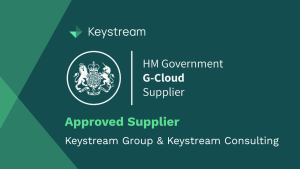
Keystream Group and Keystream Consulting have been successfully awarded places on the Crown Commercial Service G-Cloud 15 Framework.
We’re delighted to announce that both Keystream Group and Keystream Consulting have been successfully awarded places on the Crown Commercial Service G-Cloud 15 Framework. The awards provide public sector organisations with an established procurement route to access Keystream’s specialist digital and technology support capabilities through Keystream Group, alongside a growing range of digital transformation and…
Keystream awarded a place on ESPO’s Strategic HR & Recruitment Services framework
Keystream has been awarded a place on the ESPO 3S_26 Strategic HR & Recruitment Services framework, providing public sector organisations with another compliant route to access our specialist recruitment expertise. Through the framework, organisations can work with Keystream to access digital, data, technology and commercial professionals across permanent, interim and contract recruitment. This will support…
I’m taking a break
If you’re anything like me, having a break is…hard. The succession of problem-solving tasks is what I like about my day-to-day work, but I’d be lying if I didn’t occasionally come back from a break with five more things to sort and think: “what was I working on gain?” “When you get interrupted in a task, take 20 seconds to…
Digital Transformation Is Building the Bridge. Who Is Helping People Cross It?
A few years ago, I tried to teach my mum how to use a smartphone. What I thought would take a few minutes turned into weeks of explaining, reassuring, and troubleshooting. Every new feature seemed intimidating, and every mistake reinforced a fear that she might “break” something. At the time, I thought I was teaching…
Marginal Gains Could Save Lives: What the NHS Learned from Formula 1
Across the NHS, hospitals are facing increasing pressure not only from rising patient demand, but from the growing complexity of delivering safe, efficient care within constrained operational environments. Theatre capacity, staffing shortages and delayed patient flow are all placing systems under strain, where even small inefficiencies can have significant consequences. Minutes lost during patient handovers,…
AI in Higher Education: What’s Actually Changing?
There has been a noticeable rise in conversations around AI roles across Higher Education over the past year. Universities are increasingly hiring for AI specialists, data leaders, automation experts, and digital transformation professionals. But despite the recent attention, AI itself is not new to the sector. In reality, many of the technologies and skillsets now…
Saving Pennies Now Could Cost You Pounds Later: Why Data Should Drive Decision Making
Across the UK and internationally, ambulance, police and fire services are facing increasing pressures not only from rising demand, but from a quieter and more structural issue: vehicle availability. With c.8-10% of public sector fleets off the road at any given time, a growing proportion are ageing beyond their optimal operational life, leading to more…
Optimising Records Management: A Conversation with Harry Pettet
Reflecting on my time at Rewired, the opportunities that can be achieved by the NHS from maximising frontline productivity (FP) are increasingly clear to me. In line with the FP programme mandate, I saw a clear shift in focus from EPR roll-out to instead a wider scope which included championing digital enablement and adoption via…