
01.11.2021
Celebrating Neurodiversity in Tech
The world is still reeling from the aftermath of the Covid pandemic, as companies have shifted to new ways of working, adopting technologies to suit those working remotely or sometimes in different regions. According to a new study from the Confederation of British Industry (CBI) conducted with 250 companies, 67% of businesses across the United Kingdom have unfilled digital vacancies and less than a third (31%) are confident that the UK business community will be able to access the digital skills they need in the next 3-5 years. This is as a result of tech skills becoming more and more in demand across the UK. Therefore, to meet the expanding demand for digital technology skills, employers have to attract a wider talent pool.
Lets talk about neurodiversity
“Neurodiverse (ND) and neurodiversity refer to the infinite variation in cognitive functioning that can lead to differences in thinking, attention, and memory.”
Most people are neurotypical, which means the brain functions and processes information in a conventional way. Some people are neurodivergent, which means the brain functions, learns, and processes in alternative ways.
Neurodivergent individuals often have the skills employers need for digital tech roles, such as:

There is a huge untapped pool of neurodivergent talent keen to bring their sought-after skills to data analytics, cyber security, gaming, coding, design and much more in digital tech. The conditions listed below are all part of diagnostic labels used to explain the diverse ways of thinking, learning, processing and behaving. As with all people, we each have our talents and challenges.
The autism spectrum is a range of neurodevelopmental conditions generally characterised by difficulties in social interactions and communication, repetitive behaviors, intense interests, and unusual responses to sensory stimuli.
It is commonly referred to as autism or, in the context of a professional diagnosis, as autism spectrum disorder (ASD), but the latter term remains controversial among neurodiversity advocates, neurodiversity researchers, and many autistic people due to the use of the word disorder and due to questions about its utility outside of diagnostic contexts.
Throughout history, we’ve relied on our ability as a society to think differently in order to survive and thrive. With differences in thinking, neurodivergent people can bring alternative perspectives that may not have been explored before. It’s critical that organisations continue to prioritise cognitive diversity in their workforce, as every individual brings unique knowledge, experiences, and skills to the table and can help drive progress in technological innovation.
Treating each person as an individual is crucial and it’s important not to stereotype. Neurodivergent people have conditions that present differently between individuals. Like any group of people there will also be rich diversity of backgrounds and characteristics, including ethnicity, gender, and sexual orientation.
Diversity metrics in businesses are often focused on diversity in the sense of age, gender, and ethnicity. Diversity of thinking styles and cognitive differences is a newer aspect of diversity in the workplace and it’s been suggested that when companies do look to hire for neurodiversity that it’s more of a case of being fair as opposed to considering the potential performance benefits neurodivergent people can bring to a workplace.
How can the tech sector recognise and recruit neuro-diverse talent?

One of the first barriers to entry for someone who is neuro-diverse is the interview process. Traditional interviews take into consideration things like body language and awareness of social cues that can put a neuro-diverse person at a disadvantage.
However, here at Keystream Analytics (KA) we had the opportunity to employ one of our most brilliant talents in the team, who has been diagnosed with dyslexia at an early age, Jose Figueira (Data Engineer).
Jose F. shared that during his childhood “he was a slow reader, and had terrible grammar and spelling skills”. He struggled with connecting sounds to letters and distinguishing the difference between letters and words that have similar sounds (homophones), which caused him to retake his first grade at school.
This led his teachers and parents to seek the appropriate advice. He undertook speech and language therapy which has helped him immensely throughout his life.
“Being dyslexic has made me a more resilient and patient person”.
“We dyslexics portray the world through images e.g., it is easier for me to remember a picture rather than words. Normally dyslexics have excellent creative thinking, empathy and problem-solving skills. Being dyslexic has taught me a valuable lesson which is, complicated challenges are solved with determination and resilience, in other words, just keep trying and don’t give up!”.
Before joining our team, Jose F. revealed about his encounters with other interview processes where he faced difficulties with various tests including verbal & written tests. Therefore, it is important for organisations to accommodate the candidates according to their needs to avoid losing other brilliant skills the candidate may possess for the position.
Here at KA, Jose F. has settled in extremely well and has become an integral part of the team. We try to create a safe and supportive environment. In Jose’s opinion, one of the most helpful tools KA utilises is the Jira Kanban Board by Atlassian, as this helps with written instructions and daily tasks.
So what skills can neuro-diverse individuals bring to the workplace? And more specifically the tech workplace?
A study has shown that autistic people are often more naturally empathetic than neurotypical people. For a tech company this could be beneficial because it could mean understanding a customer base more and being able to deliver more innovative and meaningful products and services. The same study has shown that people who are dyslexic often have stronger analytical thinking skills. The tech industry relies heavily on highly analytical people for areas such as machine learning, data science and information analysis amongst many other tech areas.
It’s important for companies looking to hire more neurodivergent people to consider certain recruitment and workplace adjustments so they can become more inclusive and welcoming of neurodivergent talent.
As an industry, we need to work harder to educate how talent can be leveraged in different ways to fulfil these roles, because employees are often a company’s greatest asset.
Many autistic people are simply brilliant people – highly educated, highly capable, detail-orientated, yet unemployed.
Latest insights
AI in Higher Education: What’s Actually Changing?
There has been a noticeable rise in conversations around AI roles across Higher Education over the past year. Universities are increasingly hiring for AI specialists, data leaders, automation experts, and digital transformation professionals. But despite the recent attention, AI itself is not new to the sector. In reality, many of the technologies and skillsets now…

Saving Pennies Now Could Cost You Pounds Later: Why Data Should Drive Decision Making
Across the UK and internationally, ambulance, police and fire services are facing increasing pressures not only from rising demand, but from a quieter and more structural issue: vehicle availability. With c.8-10% of public sector fleets off the road at any given time, a growing proportion are ageing beyond their optimal operational life, leading to more…
Optimising Records Management: A Conversation with Harry Pettet
Reflecting on my time at Rewired, the opportunities that can be achieved by the NHS from maximising frontline productivity (FP) are increasingly clear to me. In line with the FP programme mandate, I saw a clear shift in focus from EPR roll-out to instead a wider scope which included championing digital enablement and adoption via…
Paperless? Not Without Paper First.
Sitting at my 200-year-old desk, checking a 120-year-old pocket watch, and recapping a century-old fountain pen, while dictating this into my phone and letting AI help shape it into a blog. The irony isn’t lost on me. Just before writing this, I spoke to someone who’s spent years focused on the problem, not the solution….
From Big Pharma to the Public Sector: Why I Made the Shift
Career changes are rarely about chasing a new title. For me, the move from big pharma into the public sector was about aligning my skills with work that has a more direct impact on people’s lives. For several years, I worked in the private sector supporting global clinical trials by overseeing translations of electronic clinical…
You Can’t Merge What You Can’t Measure: Safe and Legal Day 1 Starts With Data
I remember the sinking feeling clearly. I was working from my home office when my builder knocked on the door and asked if he could have “a quick word.” That phrase never means good news. He’d discovered another asbestos pipe—hidden behind a wall we’d already opened up. The bathroom renovation was delayed again. Costs climbed….
If Your CIO Isn’t at the Executive Table, Your University Is Taking a Risk
Universities don’t fail because their technology breaks. They fail because their strategy ignores technology until it’s too late. For years, Higher Education has treated IT as a delivery function – something to be consulted once the “real” decisions have been made. That mindset is now actively dangerous. In today’s sector, digital strategy is institutional strategy. And any university that doesn’t have its CIO at the executive…
Fail Fast, Serve Better: Why the Public Sector Needs a Hackathon Mindset
The electricity in the room was palpable. You could feel that surge of anticipation and excitement — the moment when your brain starts racing at 100 miles an hour and the ideas begin to spill out. We were only ten minutes into our first ever Keystream Hackathon, and already the ideas were coming so fast…
Who Owns the Roof Over Our Heads? And why it matters
Generation Alpha – the iPad-native, AI-normal, children of Millennials who think global videos, climate chat, and hand sanitiser are just… life. They’re also the least likely generation to ever own their own home. As it stands many Millennial parents will not get to see their children own their own home. That matters. As property ownership…
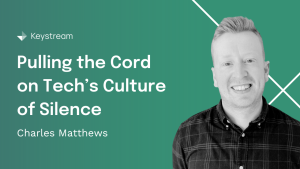
Pulling the Cord on Tech’s Culture of Silence
In aviation, every crash leads to an investigation. In tech, most failures disappear into silence. Why? After attending several events recently, one theme stood out: transparency, or the lack of it. Having supported digital and transformation leaders for over a decade, I’m struck by how often the same issues resurface. Lessons aren’t learned, and problems…