
04.02.2026
You Can’t Merge What You Can’t Measure: Safe and Legal Day 1 Starts With Data
I remember the sinking feeling clearly.
I was working from my home office when my builder knocked on the door and asked if he could have “a quick word.” That phrase never means good news. He’d discovered another asbestos pipe—hidden behind a wall we’d already opened up. The bathroom renovation was delayed again. Costs climbed. Plans changed. Confidence drained.
It wasn’t bad luck. It was bad visibility.
When we started the renovation, I thought I understood what lay beneath the surface. I didn’t. The original extension had undocumented asbestos pipes. Other services were in the wrong place. Each discovery only surfaced once we started excavating—when fixes were most expensive.
That experience is an uncomfortably accurate analogy for Local Government Reorganisation (LGR).
It’s a pattern my colleagues and I also see repeatedly in complex organisational change and transformation across local government and the NHS, where data foundations are either validated early—or paid for later.
LGR Is Building a New House on an Old Site
LGR programmes often talk about “design”: future operating models, leadership structures, digital platforms, estates strategies. It’s exciting work. It’s also where many programmes instinctively focus.
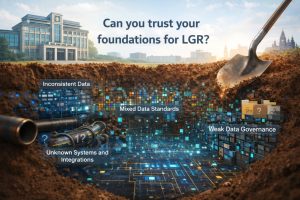
But LGR isn’t a greenfield build. It’s a new house on an old site. And data is the ground survey and foundations report.
You can design elegant architecture—org charts, service models, digital roadmaps—but if the survey is wrong, you won’t find out until you start digging. In LGR terms, that moment is vesting. And by then, corrections are slower, riskier, and far more expensive.
In our experience, this is the difference between programmes that stabilise quickly and those that spend their first year firefighting: whether the groundwork has been done deliberately, early, and in the right sequence.
Milestones Are Only as Good as Their Inputs
Anyone involved in LGR will recognise the obsession with milestones: vesting readiness, Day-1 safety and legality, cutover dates, early savings targets.
But here’s the uncomfortable question:
How do you know you can trust the data underpinning those milestones?
Across the NHS and government, we see that data is frequently:
- Inconsistent
- Incomplete
- Non-comparable
Registers don’t line up. Definitions vary. Ownership is unclear. Assumptions quietly replace evidence.
These are not just data quality issues—they are symptoms of weak data foundations: unclear governance, inconsistent definitions, and the absence of a trusted, validated source of truth. If the underlying data is wrong, every rational decision built on top of it becomes high-risk—identity, future organisation design, finance, digital, estates, supplier strategy!
When data isn’t decision-grade, LGR becomes a programme of confident guesses. And confident guesses are a fragile basis for transformation.
However, imagine if you’re data foundations are strong. You can have confidence in your decisions, your progress can be measured and you truly have evidence-based transformation.
The Pain Points We See Repeatedly
Across the public sector, where mergers occur, we see the same issues surface again and again—often after vesting, when options are limited:
- Limited understanding of the technology landscape and processes that are supported
- Mixed data standards within the new organisation meaning data does not share a single truth
- Unclear systems, integrations, and data flows
Critically, these problems don’t get easier after vesting. They compound.
“Safe and legal Day 1” depends on locking down non-negotiables across the corporate core—but those controls only work if the data driving them is trustworthy. As systems merge and access expands, weak data quality quickly becomes an operational, legal, and reputational risk.
Three Simple Frameworks That Matter More Than Any System Choice
Before talking about platforms or architectures, LGR leaders should pressure-test their data against three fundamentals:
- Accuracy – Is it actually correct within each individual council?
- Consistency – Does it mean the same thing across councils?
- Completeness – Do you have the full picture (estate, contracts, workforce, dependencies)?
Integration value doesn’t come from moving systems around.
It comes from standardising data and processes across boundaries.
What successful organisations do differently
In a nutshell, organisations that successfully navigate a merger well answer with brutal honesty, “Is my data fit for purpose and good enough to support decisions?”
After asking this question, they treat the journey to data clarity as critical path work, not a technical dependency to be picked up later. They invest early—before vesting—in a hard, honest baseline of the corporate and service data that underpins safety, legality and decision-making.
Leaders in these organisations ask a small number of uncomfortable but essential questions:
- What data do we actually trust?
- Where do definitions diverge?
- Who truly owns each critical dataset—and who is accountable for fixing it?
This work isn’t glamorous. But it is foundational.
Legacy information—whether trapped in paper records, spreadsheets or disconnected systems—creates the same visibility problem: you don’t know what you have until it becomes a blocker.
What to focus on first
The priority is not system replacement. It is shared understanding.
Four principles should guide early action:
- Clarity before convergence – Shared definitions, ownership and trust must come before system integration.
- Be brutally honest early – Exposing gaps pre-vesting is far cheaper than firefighting later.
- Make ownership explicit – Every decision-grade dataset needs a clear, accountable owner across the future organisation.
- Sequence deliberately – Data improvement should enable operating model design, digital convergence and savings, not trail behind them.
Councils should start by identifying a small number of decision-grade datasets—finance, workforce, estates, contracts, access and identity—and bringing them to a trusted, comparable and clearly owned state. These datasets underpin Day-1 safety, legality and leadership confidence.
A practical starting point is a short, leadership-level assessment testing each dataset for:
- Accuracy – can we trust it?
- Consistency – does it mean the same thing everywhere?
- Completeness – do we have the full picture?
- Ownership – who is accountable?
- Day-1 fitness – is it safe and legal to rely on?
The goal isn’t perfection; it’s honesty. A clear red/amber/green view of what is safe, risky or unknown gives leaders something far more valuable than assumed confidence: evidence-based control.
From there, councils need deliberate sequencing supported by robust transitional governance—recognising that data clarity enables every other workstream, from operating model design to digital convergence and early savings. LGR success is not defined by how quickly systems merge, but by how confidently decisions can be made on Day 1 and beyond.
Because if data is the ground beneath the new organisation, it’s better to survey it properly—before you start building.
Latest insights
Paperless? Not Without Paper First.
Sitting at my 200-year-old desk, checking a 120-year-old pocket watch, and recapping a century-old fountain pen, while dictating this into my phone and letting AI help shape it into a blog. The irony isn’t lost on me. Just before writing this, I spoke to someone who’s spent years focused on the problem, not the solution….
From Big Pharma to the Public Sector: Why I Made the Shift
Career changes are rarely about chasing a new title. For me, the move from big pharma into the public sector was about aligning my skills with work that has a more direct impact on people’s lives. For several years, I worked in the private sector supporting global clinical trials by overseeing translations of electronic clinical…
You Can’t Merge What You Can’t Measure: Safe and Legal Day 1 Starts With Data
I remember the sinking feeling clearly. I was working from my home office when my builder knocked on the door and asked if he could have “a quick word.” That phrase never means good news. He’d discovered another asbestos pipe—hidden behind a wall we’d already opened up. The bathroom renovation was delayed again. Costs climbed….
If Your CIO Isn’t at the Executive Table, Your University Is Taking a Risk
Universities don’t fail because their technology breaks. They fail because their strategy ignores technology until it’s too late. For years, Higher Education has treated IT as a delivery function – something to be consulted once the “real” decisions have been made. That mindset is now actively dangerous. In today’s sector, digital strategy is institutional strategy. And any university that doesn’t have its CIO at the executive…
Fail Fast, Serve Better: Why the Public Sector Needs a Hackathon Mindset
The electricity in the room was palpable. You could feel that surge of anticipation and excitement — the moment when your brain starts racing at 100 miles an hour and the ideas begin to spill out. We were only ten minutes into our first ever Keystream Hackathon, and already the ideas were coming so fast…
Who Owns the Roof Over Our Heads? And why it matters
Generation Alpha – the iPad-native, AI-normal, children of Millennials who think global videos, climate chat, and hand sanitiser are just… life. They’re also the least likely generation to ever own their own home. As it stands many Millennial parents will not get to see their children own their own home. That matters. As property ownership…
Pulling the Cord on Tech’s Culture of Silence
In aviation, every crash leads to an investigation. In tech, most failures disappear into silence. Why? After attending several events recently, one theme stood out: transparency, or the lack of it. Having supported digital and transformation leaders for over a decade, I’m struck by how often the same issues resurface. Lessons aren’t learned, and problems…

Tuition Fees, Talent, and Quality: The Real Challenge for UK Universities
The government’s recent announcement allowing universities in England to raise tuition fees in line with inflation has made headlines across the sector. While this move may provide welcome financial relief, the bigger challenge for universities isn’t tuition – it’s people. Universities simply cannot meet quality standards without the right teams in place. IT, digital, and…
Beyond the Tools – Making Digital Transformation Work for the NHS
I’ve seen the NHS’s digital transformation from all angles….as a patient, working on the frontline and in the programme room. I’ve felt the frustration of handwritten notes, siloed systems, and digital tools that promised productivity but rarely delivered. But I’ve also seen the difference when technology truly works, when it empowers rather than overwhelms, when it simplifies rather than complicates, and when it supports…
The Traitors Within: Tackling Hidden Inefficiencies in NHS Waiting List Management
As The Traitors returns to our screens tonight (highly recommend if you haven’t seen it), it’s a good reminder that not every challenge is visible at first glance – especially in healthcare. Just like in the show, NHS teams are working together towards a shared goal, but sometimes unseen forces quietly work against progress. In…