
09.11.2026
Bolton Cares: Build the future. Then deploy the technology.
View the full interview with Rhian Stone, Chief Executive, Bolton Cares here.
When social care provider LATCO, Bolton Cares, needed to replace its Digital Care Recording System, Chief Executive Rhian Stone chose to ask a bigger question: how should our organisation work in the future to deliver on our purpose? She talks to Isaac Vivian, Local Government Lead at Keystream Consulting, about what changed, why the approach mattered and what other public service leaders can learn.
Back in May, what challenges was Bolton Cares facing, and why didn’t you simply replace the digital care recording system?
We’d spent years moving from paper to digital, introducing different systems under considerable pressure. The trouble was, they weren’t really speaking to each other. That created frustrations and workarounds across the business, especially for our colleagues delivering care. Then our care recording provider told us its system would no longer be available from April 2027.
It was a huge headache, but also an opportunity. We could rush out and buy a replacement, or pause and think about how we wanted Bolton Cares to work in the future. I wanted to start with how we deliver the best possible care, then ask what technology would help us get there. Otherwise, we’d risk investing in something new that simply embedded yesterday’s problems.
What was different about working with Keystream Consulting, and what did involving your people help you discover?
Keystream stood out during procurement. You’d understood our brief, done your homework and recognised that the people we support had to be centre stage. It felt genuinely bespoke, rather than an off-the-shelf offer we’d have to fit ourselves into.
That wasn’t just a promise. Your team was visible throughout, working alongside our registered managers, support workers, ICT and central services. Keystream brought people together
for some very honest workshops, creating space to explore problems properly. We could challenge your thinking, and you listened.
That collaboration helped us get beneath the symptoms and understand what wasn’t working. What surprised me was the amount of management time lost to duplication and spreadsheets created to work around systems and processes. Keystream helped us see the scale of that, but also reflected back the capability and commitment of our operational teams,
which gave people a real boost. We’d been trying to tackle these issues ourselves; having that external impetus made a real difference. You did what you promised, and we could see that you genuinely cared about our organisation and the change.
What difference has the work made, and how is it shaping Bolton Cares’ next technology investment?
The target operating model Keystream developed with us gave us a shared picture of how the organisation should work. Many recommendations weren’t digital at all: they addressed how frontline, ICT and central teams should work together going forward. Keystream also brought the technical expertise to get under the bonnet of our existing systems and data architecture, helping us understand not just how we needed to work differently, but what technology and integrations would be needed to make that possible.
I was slightly worried about what would happen when Keystream left. Instead, the momentum has continued. Teams are implementing recommendations together. Previously, conversations could become about whether something was ICT’s fault or operations’ fault. Now there’s more shared problem-solving, with frontline colleagues involved in decisions. That’s a signifi cant cultural shift.
We already had capable teams delivering good care. Keystream helped us identify the friction getting in their way. Our new system requirements now reflect what staff need, and we’re planning to invest much more in helping people through implementation. There’s plenty still to deliver, but we’re better equipped to do it ourselves.
What advice would you give another chief executive, and what do you hope to share at the LATCo workshop?
Don’t start by shopping for technology. Start by understanding the problem you’re trying to solve and what needs to change in your organisation to solve it. Listen to the people delivering services to understand what’s working, what isn’t and where the gaps are. Only then decide what technology to buy or build, and fi nd partners who will help your teams lead and own that change.
When Isaac and I deliver our workshop Build the Future. Then Deploy the Tech at the national LATCo conference workshop next April, I’m confident we can share the progress in the implementation of our operating model; a new care recording system having been introduced, and a continuing cultural shift of momentum. Above all, every decision will start with the people we support and our employees who support them. Technology should follow that purpose, not define it.
Rhian Stone and Isaac Vivian will speak at the LATCO conference in April 2027
Latest insights
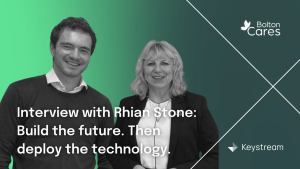
Bolton Cares: Build the future. Then deploy the technology.
View the full interview with Rhian Stone, Chief Executive, Bolton Cares here. When social care provider LATCO, Bolton Cares, needed to replace its Digital Care Recording System, Chief Executive Rhian Stone chose to ask a bigger question: how should our organisation work in the future to deliver on our purpose? She talks to Isaac Vivian,…
In an AI World, Presence Still Matters
Over the last few years, I’ve found myself having more and more conversations about artificial intelligence. With clinicians. With operational leaders. With administrators. With digital teams. Whether it’s generative AI, automation, predictive analytics or broader digital transformation, there is a genuine sense that we are entering a period of significant change. The opportunities are exciting….
What Cameron Diaz and Jude Law can Teach us about AI Transformation
“You are, seriously, the most depressing girl I’ve ever met.” I admit, not the most obvious place to start a blog about AI transformation, but stay with me. In one of my favourite rom coms, The Holiday, Cameron Diaz’s character Amanda is trying to work out what happens next in her relationship with Graham, played…
If a picture is worth a thousand words, a prototype is worth a thousand meetings
Until recently, building something interactive enough to have a conversation and drive decisions could take days or weeks. You might need a designer, a developer, or enough budget to make the exercise worthwhile. A rough prototype can now be produced in hours, sometimes minutes. Which means the threshold for saying “instead of discussing it, shall…
Keystream Group and Keystream Consulting have been successfully awarded places on the Crown Commercial Service G-Cloud 15 Framework.
We’re delighted to announce that both Keystream Group and Keystream Consulting have been successfully awarded places on the Crown Commercial Service G-Cloud 15 Framework. The awards provide public sector organisations with an established procurement route to access Keystream’s specialist digital and technology support capabilities through Keystream Group, alongside a growing range of digital transformation and…
Keystream awarded a place on ESPO’s Strategic HR & Recruitment Services framework
Keystream has been awarded a place on the ESPO 3S_26 Strategic HR & Recruitment Services framework, providing public sector organisations with another compliant route to access our specialist recruitment expertise. Through the framework, organisations can work with Keystream to access digital, data, technology and commercial professionals across permanent, interim and contract recruitment. This will support…
I’m taking a break
If you’re anything like me, having a break is…hard. The succession of problem-solving tasks is what I like about my day-to-day work, but I’d be lying if I didn’t occasionally come back from a break with five more things to sort and think: “what was I working on gain?” “When you get interrupted in a task, take 20 seconds to…
Digital Transformation Is Building the Bridge. Who Is Helping People Cross It?
A few years ago, I tried to teach my mum how to use a smartphone. What I thought would take a few minutes turned into weeks of explaining, reassuring, and troubleshooting. Every new feature seemed intimidating, and every mistake reinforced a fear that she might “break” something. At the time, I thought I was teaching…
Marginal Gains Could Save Lives: What the NHS Learned from Formula 1
Across the NHS, hospitals are facing increasing pressure not only from rising patient demand, but from the growing complexity of delivering safe, efficient care within constrained operational environments. Theatre capacity, staffing shortages and delayed patient flow are all placing systems under strain, where even small inefficiencies can have significant consequences. Minutes lost during patient handovers,…
AI in Higher Education: What’s Actually Changing?
There has been a noticeable rise in conversations around AI roles across Higher Education over the past year. Universities are increasingly hiring for AI specialists, data leaders, automation experts, and digital transformation professionals. But despite the recent attention, AI itself is not new to the sector. In reality, many of the technologies and skillsets now…